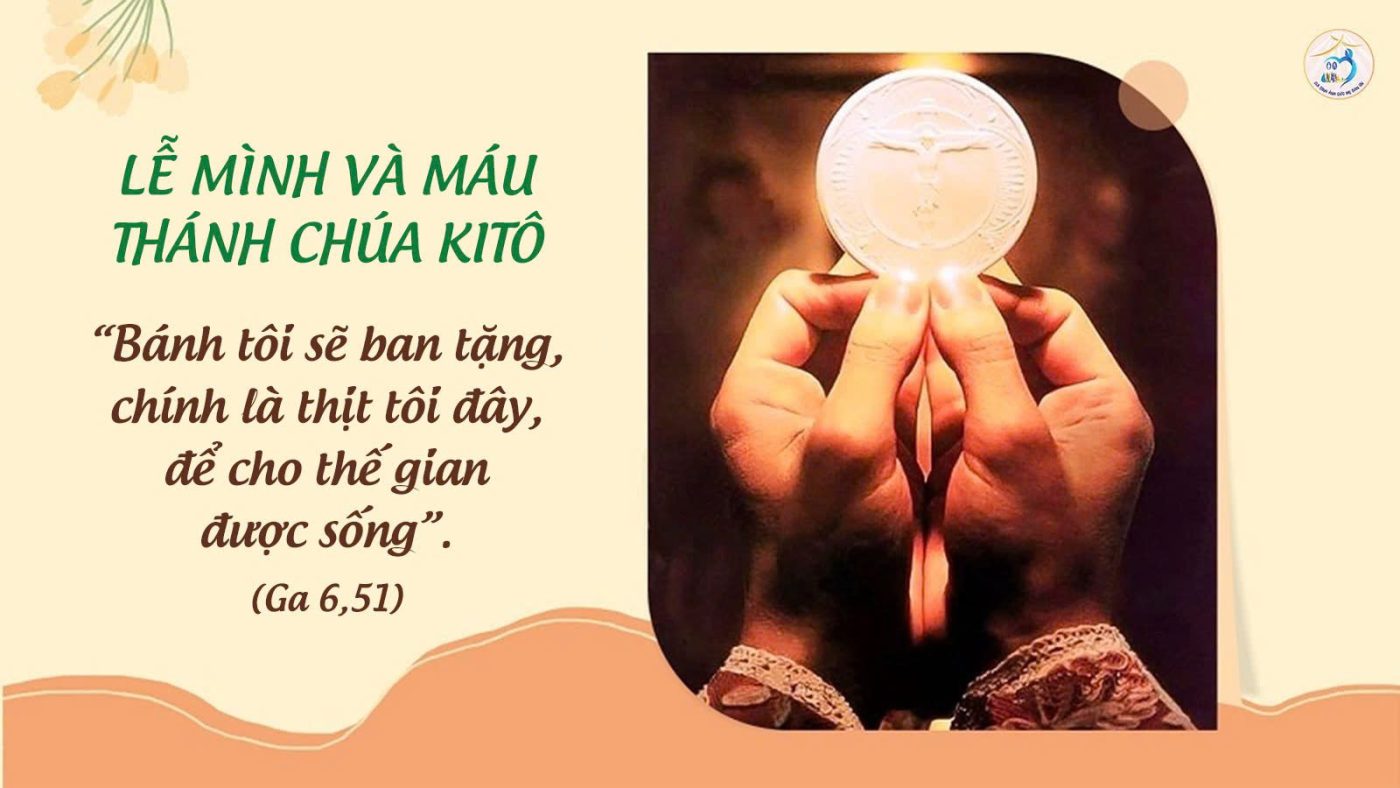
LỄ MÌNH VÀ MÁU THÁNH CHÚA KITÔ
Ga 6,51-58
(Link bài Phúc Âm: https://bom.so/F2LS37)
“Bánh tôi sẽ ban tặng, chính là thịt tôi đây,
để cho thế gian được sống”
(Ga 6,51)
CHIÊM NGẮM MẸ SỐNG TIN MỪNG
Thánh Vinh Sơn Phaolô, với tư cách là Bề trên, đã dành lời khích lệ cho một tu huynh của Tu Hội Truyền Giáo đang hấp hối: “Tình yêu thì sáng tạo đến vô tận.” Ngài giải thích lý do Chúa Giêsu thiết lập Bí Tích Thánh Thể trước khi từ giã thế gian về cùng Chúa Cha, tất cả chỉ vì tình yêu: sự vắng mặt của Người có thể làm chúng ta lãng quên hay nguội lạnh trong lòng, nên Người muốn hiện diện cách thực sự và bản thể. Người lại còn muốn hạ mình hơn nữa so với khi Nhập thể, để trở nên giống chúng ta hơn, hoặc ít nhất làm cho chúng ta nên giống Người hơn, bằng cách làm cho Bí tích khả kính này trở nên của ăn và của uống cho chúng ta: “Nếu các ông không ăn thịt và uống máu Con Người, các ông không có sự sống nơi mình.”
Bài đọc I nhắc lại lời ông Môsê nói trong sa mạc: “người ta sống không chỉ nhờ cơm bánh, nhưng còn sống nhờ mọi lời miệng Đức Chúa phán ra.” Vì chính nhờ Lời Chúa phán mà có Manna như sương trời đọng lại trên mặt đất, nuôi sống họ.
Từ đó, Chúa Giêsu – Ngôi Lời Thiên Chúa – mời họ đón nhận sự sống thần linh từ chính bản thân Người: “Tôi là bánh hằng sống từ trời xuống. Ai ăn bánh này, sẽ được sống muôn đời. Và bánh tôi sẽ ban tặng chính là thịt tôi đây, để cho thế gian được sống” (c.51). Nhiều người Do Thái ngỡ ngàng không hiểu lời ấy, Chúa Giêsu giải thích cho họ hiểu nguyên lý “sống nhờ”: “Tôi sống nhờ Chúa Cha thế nào, thì kẻ ăn tôi cũng sẽ nhờ tôi mà được sống như vậy” (c.57), và đó là sự sống đời đời.
Để trở thành Kitô hữu, là “người có chất Kitô” trong mình, ta cần sống nhờ Đức Kitô, như thai nhi sống nhờ máu thịt của mẹ suốt 9 tháng, khi ra đời tiếp tục sống nhờ dòng sữa mẹ để lớn lên. Rồi để tồn tại và phát triển, ta còn phải ăn uống để nuôi dưỡng cơ thể mỗi ngày. Như thế, thật dễ hiểu biết bao: Để nuôi sống đời sống Kitô hữu đời này, ta cũng phải đón nhận Thánh Thể Chúa, nhờ đó, ta có đủ sức mạnh đi tới đời sau.
Đức Thánh Giáo Hoàng Gioan Phaolô II đã gọi Đức Maria là “Người Nữ Thánh Thể”. Mẹ là Nhà Tạm đầu tiên cất giữ Chúa Giêsu Thánh Thể, và qua bài Magnificat, Mẹ còn là người đầu tiên tôn thờ, ngợi khen Thánh Thể trong chính cung lòng mình.
Là Người Nữ Thánh Thể, Mẹ luôn quan tâm đưa dẫn con cái tới Chúa Giêsu Thánh Thể. Thật vậy, năm 1830, khi hiện ra với Sơ Catherine Labouré, Đức Mẹ đã dạy Sơ: “Hãy đến nơi chân bàn thờ này (tay Đức Mẹ chỉ vào nhà Tạm). Nơi đây, nhiều ơn lành sẽ được tuôn ra cho mọi người lớn nhỏ đến cầu xin.”
SỐNG TIN MỪNG VỚI MẸ:
Nhớ lời Mẹ dặn, tôi tham dự thánh lễ và rước lễ mỗi ngày cách sốt sắng, năng chầu Thánh Thể và Rước Lễ thiêng liêng, đồng thời tập có sáng kiến biểu lộ tình bác ái với tha nhân như Chúa.
CẦU NGUYỆN VỚI MẸ:
Lạy Mẹ Maria, xin dạy con biết chiêm ngắm, tôn thờ và yêu mến Chúa Giêsu Thánh Thể như Mẹ đã yêu mến Người. Xin Mẹ giúp con biết dọn mình cẩn thận khi rước Chúa, và thờ lạy, cám ơn Chúa thật sốt sắng, để con được sống nhờ sức sống của Chúa, nên một với Chúa ngay ở đời này và được sống đời đời. Amen.
Lạy Mẹ Maria Vô nhiễm Nguyên tội
Xin cầu cho chúng con hằng chạy đến kêu xin Mẹ.
————-o0o————
June the 7th 2026
THE TENTH SUNDAY IN ORDINARY TIME – YEAR A
FEAST OF THE HOLY BODY AND BLOOD OF CHRIST, YEAR A
(Jn 6,51-58)
(Link to the Gospel: https://bom.so/F2LS37)
“This bread is my flesh, which I give for the life of the world”
(Jn 6,51)
CONTEMPLATE MARY LIVING THE GOOD NEWS
As Superior, Saint Vincent de Paul offered words of encouragement to a religious brother of the Missionary Congregation who was dying: “Love is endlessly creative.”He explained the reason why Jesus instituted the Eucharist Sacrament before departing from this world so as to be with the Father, all of this institution is just out of love: His absence can cause us to forget or to grow cold in our hearts, He hence wishes to be present in a real and substantial way. He’s even more willing to humble Himself than He was at the Incarnation, in order to become more like us, or at least to cause us to be more like Him, by making this venerable Sacrament become our food and drink: “Unless you eat the flesh of the Son of Man and drink his blood, you have no life in you.”
Moses’ words in the desert were recalled in the First Reading: “Man shall not live on bread alone, but on every word that comes from the mouth of the Lord.” It was really owing to the Lord’s words, that there were mannas which condensed on the earth and resembled dew from the sky, by which their lives were sustained.
From these ones, they were invited by Jesus – God’s Word – to receive the divine life from Himself: “I am the living bread that came down from heaven. Whoever eats this bread will live forever. This bread is my flesh which I give for the life of the world” (s. 51). Being astonished, many Jews didn’t understand these words, they were explained by Jesus the principle of “living because of”: “I live because of the Father, so the one who feeds on me will live because of me” (s.57), and that is eternal life.
For the purpose of becoming a Christian, of being “a person with Christian qualities” within us, we need to live because of Christ, just as a foetus who lives because of his / her mother’s blood and flesh for nine months, and after birth, he /she will continue to live because of his / her mother’s milk in order to grow. Then we still have to eat and drink to nourish our bodies every day, so as to survive and develop. Therefore, how easy it is to understand that: For the sake of nourishing our Christian life in this world, we must receive the Holy Eucharist as well, thanks to that One, we have enough strength to reach the afterlife.
Mary was called by St. Pope John Paul II as “the Eucharistic Woman”. She was the first Tabernacle where the Eucharistic Jesus was stored, and through the Magnificat canticle, She was also the first person Who adored and praised the Eucharist in Her own womb.
As the Eucharistic Woman, Mary has unceasingly cared about leading Her children to the Eucharistic Jesus. While appearing to Sister Catherine Labouré in 1830, Mary indeed instructed her: “Come to this altar foot (She pointed to the Tabernacle). Here, many blessings will flow for everyone who comes to pray, the young and the old.”
Remembering Mary’s words, I devotionally attend Mass and receive the Holy Communion daily, I diligently adore the Eucharist and I spiritually receive the Holy Communion, I concurrently practise taking the initiative to express the charity to others as Christ did.
PRAY TO MARY
O Mary, teach me to be aware of contemplating, adoring and loving Jesus in the Eucharist as You loved Him. Assist me in carefully preparing myself each time when I receive Jesus, in adoring and thanking Him with great devotion, so that I may live because of His life, I may become one with Him right in this life and I’ll have eternal life. Amen.
O Mary conceived without sin,
Pray for us who have recourse to You.
